Let’s discuss your container requirements
01708 225350
Call Us
sale@modularmarbles.com
Email Us

Top 10 Circuit Breaker Manufacturers in the World

Circuit breakers rarely attract attention until a fault turns a quiet room into a sharp click, a warning light, or an unexpected shutdown. Yet these devices protect people, equipment, and continuity of service across homes, factories, data centers, and power networks. The manufacturers behind them must balance interrupting capacity, reliability, safety, and increasingly compact designs. Small details matter: a breaker’s rated voltage, trip curve, and ability to withstand repeated operation can shape the performance of an entire installation.

Market figures underline the sector’s scale, though forecasts vary by research scope. MarketsandMarkets estimated the global circuit breaker market at about USD 8.6 billion in 2023, with growth projected through 2028. Such estimates are useful context, not a guarantee of future demand. The International Energy Agency’s Electricity Grids and Secure Energy Transitions report also highlights the need for substantial grid investment as electricity use and renewable generation expand. That pressure makes dependable switching and protection equipment more consequential.

As Schneider Electric’s electrical-protection specialist John Voeller puts it, “A circuit breaker is only as reliable as the system it protects.” This practical point deserves a closer look: product performance depends on correct selection, installation, and maintenance, not branding alone. The following overview compares ten leading Circuit Breaker Manufacturers by global presence, product range, technical capabilities, and reputation. It is a starting point, not a substitute for project-specific engineering review.
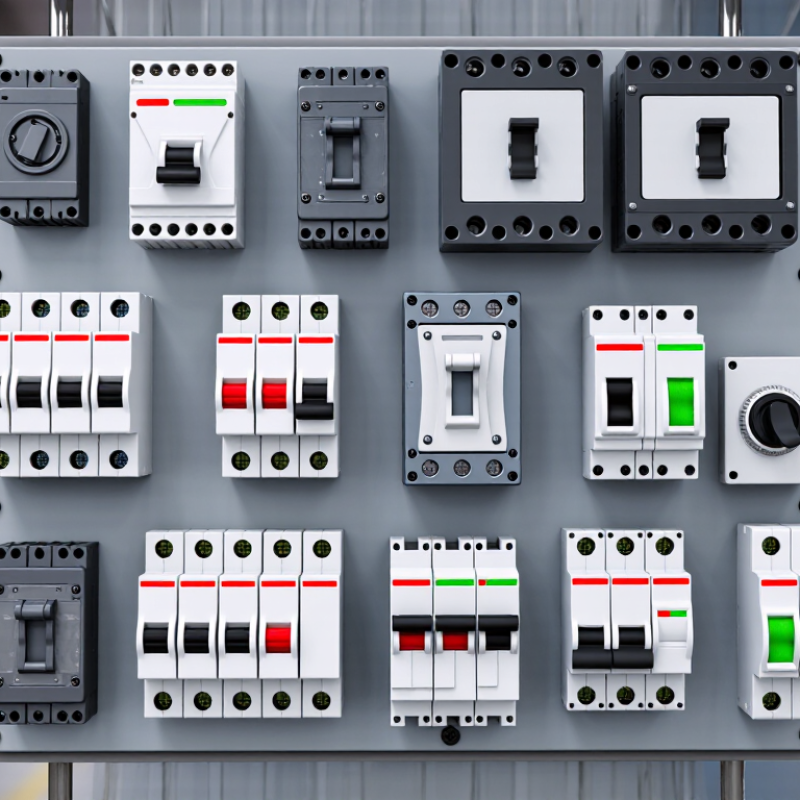
Top 10 Circuit Breaker Manufacturers in the World

Circuit Breakers Defined: IEC 60947-2 Covers Ratings up to 1,000 V AC

IEC 60947-2 sets requirements for circuit breakers used in low-voltage installations. Its scope covers equipment rated up to 1,000 V AC or 1,500 V DC. That voltage limit describes the operating range, not how much fault current a breaker can safely interrupt. Check the device’s rated ultimate and service short-circuit breaking capacities, Icu and Ics, against the installation’s calculated fault level. A neat panel label cannot replace that calculation.

The distinction matters as electricity demand rises. The International Energy Agency’s Electricity 2025 report estimates global electricity demand grew by 4.3% in 2024. More loads mean more attention to protection coordination, especially in compact distribution boards serving motors, chargers, and building systems. In practice, engineers compare trip settings with cable ratings and downstream devices, then verify selectivity under expected fault conditions. Small details matter.

IEC 60947-2 also addresses operating performance and verification, helping buyers compare breakers on consistent technical grounds. Still, matching a catalogue rating to a system is not enough. Ambient temperature, enclosure heat, installation altitude, and conductor sizing can affect real performance. A breaker may look correct on paper. It may not be correct in a crowded cabinet. Selection should use the current standard edition, manufacturer test data, and a site-specific protection study; even experienced teams can overlook derating.

Circuit Breakers Defined: IEC 60947-2 Covers Ratings up to 1,000 V AC

Voltage reference points for low-voltage circuit-breaker applications. IEC 60947-2 applies to circuit breakers in circuits with rated voltages up to 1,000 V AC; the lower values shown are common nominal system voltages, not a manufacturer ranking.

How the Top 10 Manufacturers Are Compared: Standards, Product Range, and Reach

Comparing the top 10 circuit breaker manufacturers takes more than checking product catalogs. Standards are a practical starting point: review whether each product is tested to relevant international or regional requirements, and confirm its voltage, current, and interrupting ratings. Ask for current test documentation, not just a standards list. A breaker’s performance depends on its intended installation and operating conditions.

Product range shows how well a manufacturer can support different projects. Compare miniature, molded-case, and air circuit breakers, then check available pole configurations, accessories, and monitoring options. For example, a panel designer may need compact units for branch circuits and higher-capacity breakers for main distribution. Reach also matters: local technical support, documented delivery coverage, and access to replacement parts can affect maintenance over time. A wide footprint alone proves little.

Tips: Match the breaker’s ratings to the system design, and verify compatibility with the panel and accessories. Compare documentation side by side. Small omissions can matter. Manufacturer data may also differ in detail, so record assumptions before ranking suppliers. A clear comparison is useful, but it cannot replace qualified engineering review for a specific installation.

Global Manufacturer Profiles: Breaker Technologies, Applications, and Market Strengths

Circuit breaker manufacturers differ in more than rated current or product range. Their strengths often reflect the environments they serve: compact molded-case units for commercial panels, air circuit breakers for large facilities, and vacuum or gas-insulated designs for medium-voltage networks. The details matter. A breaker installed in a dusty factory faces different demands from one protecting a hospital’s backup-power system.

Technology profiles should be compared against real operating conditions. Look at interruption capacity, trip-unit settings, temperature limits, maintenance access, and compatibility with monitoring systems. A clear technical document can be more useful than a broad performance claim. For example, technicians need to know whether a trip setting can be adjusted on site and how inspection intervals change under frequent switching. Small details, but important.

Market strength also depends on dependable supply, application support, and access to replacement parts. Manufacturers serving data centers may emphasize selectivity and coordination, while those focused on utilities may prioritize grid reliability and field service. No single design fits every installation. Published specifications still need careful review, and site conditions can expose gaps that catalog pages overlook. That part is easy to miss.

Low- and High-Voltage Breakers: IEC 60947-2 and IEC 62271-100 in Context

Low- and high-voltage breakers serve different parts of the power system, and their standards should not be treated as interchangeable. IEC 60947-2 covers low-voltage circuit breakers, generally used in installations up to 1,000 V AC or 1,500 V DC. IEC 62271-100 addresses high-voltage AC circuit breakers above 1 kV. The distinction matters on a factory floor: a compact breaker in a distribution panel faces different fault conditions from a substation breaker interrupting a large short-circuit current. Ratings, test procedures, and installation conditions all need careful review.

The International Energy Agency’s Electricity Grids and Secure Energy Transitions report estimates that more than 80 million kilometres of grids need to be added or refurbished by 2040. That scale makes dependable switching equipment essential, but compliance alone is not a complete selection strategy. Engineers should check rated voltage, breaking capacity, endurance, and the conditions used for type tests. Small details matter. A breaker tested at one frequency or operating temperature may not perform identically in another setting. The IEA’s Electricity 2024 report also projects global electricity demand growth of around 4% in 2024 and 2025, increasing pressure on networks. Standards create a common technical baseline; site-specific verification still takes experience, and it can be overlooked.

Top 10 Circuit Breaker Manufacturers in the World — Low- and High-Voltage Breakers: IEC 60947-2 and IEC 62271-100 in Context

No. Comparison Dimension Low-Voltage Context High-Voltage Context What Buyers Should Verify
1 Applicable IEC standard IEC 60947-2 covers circuit-breakers within the scope of low-voltage switchgear and controlgear. IEC 62271-100 covers alternating-current circuit-breakers within the scope of high-voltage switchgear and controlgear. Check the exact standard edition and product certification stated in the technical documentation.
2 Voltage range context Low-voltage systems commonly operate at rated voltages up to 1,000 V AC or 1,500 V DC, subject to the applicable product standard and device rating. IEC 62271 equipment is for systems above 1 kV; IEC 62271-100 addresses AC circuit-breakers. Confirm rated voltage, system voltage, insulation level, and whether the application is AC or DC.
3 Typical installation Distribution boards, motor control centres, and low-voltage switchboards. Substations, transmission networks, and high-voltage switchgear assemblies. Assess enclosure, mounting, indoor or outdoor service, and the installation environment.
4 Current rating Rated current is selected for the protected circuit and the breaker’s declared operating conditions. Rated normal current is selected for the power-system load and equipment design. Compare the declared rating with load, conductor, busbar, and temperature-rise requirements.
5 Fault interruption Breaking-capacity ratings indicate the fault-current level the breaker can interrupt under specified conditions. Rated short-circuit breaking current and related performance ratings are important for network fault duties. Verify the prospective fault current at the installation point and the applicable test ratings.
6 Short-time withstand Coordination may require the breaker to withstand fault current for a specified short duration. Short-time withstand current and duration are key parameters for switchgear and protection coordination. Check withstand ratings against the protection clearing time and system study.
7 Operating mechanism Manual, motor-operated, or stored-energy mechanisms may be available depending on breaker design. Operating mechanisms are designed to perform switching operations at the rated conditions of the equipment. Review operating duty, control supply, mechanical endurance, and maintenance requirements.
8 Protection and control Electronic or thermal-magnetic trip units can provide overcurrent protection, depending on the product. Protection and control functions are commonly coordinated with external relays and substation control systems. Confirm protection settings, trip interfaces, communications, and compatibility with the protection scheme.
9 Environmental conditions Ambient temperature, enclosure, altitude, and pollution conditions may affect ratings and selection. Outdoor exposure, temperature, altitude, seismic conditions, and site pollution may affect equipment selection. Check declared service conditions and any required derating or special design provisions.
10 Evidence for comparison Useful evidence includes datasheets, type-test information, trip-unit details, and installation instructions. Useful evidence includes rated-performance data, type-test documentation, operating-duty information, and maintenance instructions. Compare verified technical documentation rather than relying on a manufacturer ranking alone.

Note: This table provides a manufacturer-neutral comparison framework. It does not rank or identify manufacturers; breaker ratings and features vary by product and must be confirmed against the relevant documentation and project requirements.

Industry Trends: Smart Protection, Grid Reliability, and Electrification

Top 10 Circuit Breaker Manufacturers in the World

Industry Trends: Smart Protection, Grid Reliability, and Electrification

Circuit breakers are becoming data points as well as safety devices. Sensors can track temperature, operating cycles, and fault events, helping maintenance teams spot wear before a failure interrupts service. The International Energy Agency’s Electricity 2025 report says global electricity demand grew by 4.3% in 2024. More electric vehicles, heat pumps, and data centers are adding pressure to distribution networks. Protection equipment must respond quickly, but it also needs to communicate clearly with monitoring systems. Small signals matter.

Grid investment is another driver. The IEA’s 2023 report, Electricity Grids and Secure Energy Transitions, estimates that more than 80 million kilometres of grids must be added or refurbished by 2040 to meet national climate goals. That scale makes reliability a practical concern: a failed breaker can affect a factory line, a hospital circuit, or a neighbourhood feeder. Digital diagnostics may reduce unnecessary inspections, yet software cannot replace sound installation and testing. Nor does every site need the same level of connectivity. The industry’s challenge is choosing protection that fits real operating conditions, while leaving room for upgrades. That balance is easy to overlook.

We are proud to support

Registered Company Name: Upminster Containers Limited. Registered Address: Mardyke Works, St Mary's Lane, Upminster, Essex RM14 3PA. Registered Company Number: 00940382
Developed & Maintained By Space Rocket Digital.
chevron-down