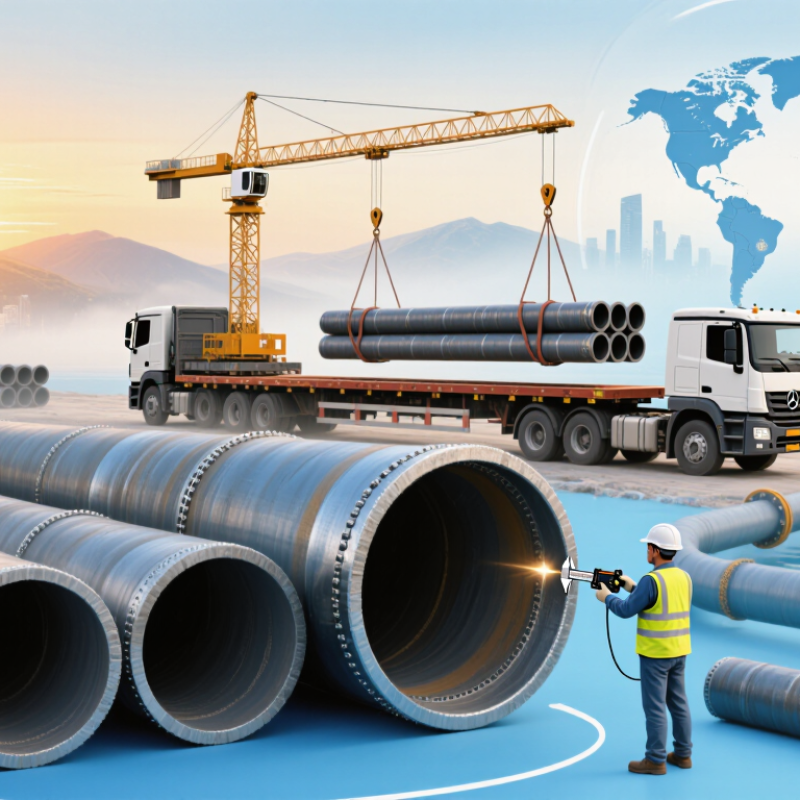
Global projects demand more than a pipe that looks strong in a warehouse. They require predictable performance across long distances, changing climates, and demanding installation conditions. Welded Steel Pipe often answers this need through controlled production, consistent dimensions, and flexible wall-thickness options. Its welded seam also allows manufacturers to produce large diameters efficiently, supporting water systems, energy infrastructure, structural works, and industrial networks.
Dr. Alan Cramb, a metallurgical engineer and former steel-industry executive, has said, “Steel is not simply a product; it is a process controlled from raw material to finished form.” This principle is important when selecting Welded Steel Pipe. Experienced project teams review steel grade, welding procedure, heat treatment, non-destructive testing, and coating requirements together. They do not judge performance from price alone. A pipe may appear economical, yet poor surface preparation can create expensive maintenance later.
Details matter. Inspectors may examine weld profiles, ultrasonic test records, coating thickness, and dimensional tolerances before shipment. Engineers also consider transport routes, flange connections, soil chemistry, operating pressure, and local standards such as API, ASTM, or ISO requirements. These checks build traceability and reduce uncertainty between the mill and the jobsite.
Still, Welded Steel Pipe is not automatically the best answer for every application. That assumption can fail. Extreme corrosion, unusual pressure cycles, or limited inspection access may require another design. A reliable decision therefore balances technical evidence, field experience, lifecycle cost, and supplier capability. When those factors align, welded steel becomes more than a material choice; it becomes a practical foundation for durable global infrastructure.
Welded steel pipe is made from flat steel plate or coil shaped into a round section. Its edges are then joined along a continuous seam. The manufacturing route affects strength, cost, and dimensional accuracy. Common methods include electric resistance welding and submerged arc welding. Each method suits different wall thicknesses and project demands.
During production, operators unwind the coil, level it, and form it through carefully aligned rollers. Welding heat must remain stable. Too much heat can weaken the seam, while too little may create incomplete bonding. After welding, the pipe is sized, cut, and inspected. Ultrasonic testing, visual checks, and hydrostatic pressure tests can reveal hidden defects. In practical projects, small alignment errors sometimes appear after forming. They require correction, not assumption.
Tips: Confirm the required grade, diameter, wall thickness, and end finish before ordering. Ask for weld inspection records and material test certificates. Match the coating system to soil, humidity, saltwater, or chemical exposure. Store pipes on supports, away from standing water. Do not drag them across rough ground. That simple mistake can damage protective coatings. Experienced engineers also review temperature changes and installation loads, because a pipe suitable for one region may need different specifications elsewhere. During site work, records should connect each pipe batch with its inspection results. This makes quality decisions clearer when questions arise.
Welded steel pipe offers practical strength for international construction. It is formed from steel plate or coil, then joined along a controlled seam. This process supports consistent diameters and flexible wall thicknesses. The World Steel Association reported 1.89 billion tonnes of crude steel production in 2023. That scale supports broad material availability across major supply regions. However, availability does not guarantee suitability.
For overseas projects, welded pipe simplifies transport and project planning. Standard lengths can reduce field cutting, lifting time, and material waste. Modern ultrasonic and radiographic testing can identify seam defects before shipment. Recognized standards also define chemistry, dimensions, pressure performance, and inspection records. Yet welded pipe is not flawless. Poor alignment, residual stress, or incomplete coating can create expensive failures. Site teams should review mill certificates, weld procedures, and third-party inspection results. The International Organization for Standardization’s quality principles emphasize traceability and controlled production, not paperwork alone. That distinction matters at remote construction sites.
Tips: Match pipe grade and wall thickness to pressure, soil movement, and temperature. Protect bare surfaces during sea transport. Check ovality after unloading. Keep photographs and test records together. A small documentation gap can delay installation. Engineers should also question unusually low quotations. The cheapest pipe may carry hidden inspection, coating, or replacement costs. In practice, project assumptions sometimes look cleaner than field conditions. Allowing contingency for weather, handling damage, and local welding skill makes the specification more reliable.
Why Choose Welded Steel Pipe for Global Projects?
Welding method directly shapes pipe quality, service life, and inspection needs. Electric resistance welding creates a narrow seam and supports consistent production. However, unstable heat input can leave hidden inclusions or incomplete fusion. Longitudinal submerged arc welding offers strong penetration for large-diameter pipe. Spiral submerged arc welding improves material efficiency, but its helical seam needs careful alignment control.
The World Steel Association reported 1.89 billion tonnes of crude steel production in 2023. This scale supports welded pipe supply across many regions. Yet availability does not guarantee performance. The AMPP IMPACT study estimated global corrosion costs at about $2.5 trillion annually, equal to nearly 3.4% of global GDP. Weld geometry, heat-affected zones, coating preparation, and field welding can all influence that cost. API Specification 5L and project specifications require qualified procedures, traceability, and non-destructive testing. A smooth weld can still conceal porosity. That uncomfortable detail deserves attention. In practice, radiographic or ultrasonic results should be reviewed with hydrostatic testing and visual inspection. One method is never enough.
Tips: Match the process to diameter, wall thickness, pressure, and transport conditions. Check welder qualifications and procedure records before production. Inspect seam ends, especially after cutting or repair. Keep mill certificates connected to each pipe bundle. A perfect report can still miss a poor site weld. Reflect on that risk before approval.
Why Choose Welded Steel Pipe for Global Projects?
Standards, Specifications, and Inspection Requirements for Global Projects
Welded steel pipe can support long-distance water, energy, and structural systems when specifications are controlled carefully. Its manufacturing process allows consistent wall thickness, large diameters, and efficient material use. Yet “international standard” is not a complete specification. The project must identify the required code, material grade, pipe size, wall thickness, end preparation, and service conditions.
Common references include API 5L, ISO 3183, ASTM standards, and EN 10217. Each may define different chemical limits, testing rules, and acceptance criteria. A purchasing document should state the exact edition and supplementary requirements. Temperature matters. Corrosive soil matters too. A pipe suitable for a dry utility line may fail in seawater service without proper protection.
Inspection should begin with certified material records and heat-number traceability. Inspectors normally verify dimensions, surface condition, weld appearance, and marking. Ultrasonic or radiographic testing may examine weld integrity. Hydrostatic testing checks pressure resistance, but it cannot reveal every long-term corrosion risk. Coating thickness should be measured at several points, including weld areas and pipe ends.
Small details matter.
A realistic inspection plan also defines sampling rates, calibration records, repair limits, and documentation formats. Independent inspection can improve confidence, especially when suppliers and construction sites are far apart. Still, paperwork is not proof of perfect quality. A checklist may miss poor storage, damaged bevels, or moisture trapped beneath coatings. Site teams should inspect received pipes again, even when the certificates look complete.
| Data Dimension | Typical Requirement or Specification | Common International Reference | Inspection and Verification | Project Value |
|---|---|---|---|---|
| Product Definition | Longitudinally welded or helically welded steel pipe manufactured from plate or coil. The manufacturing route shall be selected according to diameter, wall thickness, service conditions, and applicable standard. | ISO 3183; API Specification 5L; EN 10217 series; EN 10219 series for structural hollow sections | Review of manufacturing procedure, material traceability, weld procedure qualification, and production records. | Welded production can provide a broad range of diameters and wall thicknesses with efficient material utilization. |
| Line Pipe Standard | For oil and gas transportation, the pipe is commonly specified to a recognized line-pipe standard with defined chemical, mechanical, dimensional, testing, and marking requirements. | ISO 3183 or API Specification 5L, subject to the contract and regulatory requirements | Check the standard edition, product specification level, grade designation, pipe type, and purchaser-specific additions on the purchase order. | A clearly defined standard improves consistency when suppliers, inspectors, and project sites are located in different countries. |
| Product Specification Level | PSL1 generally provides basic standardized requirements. PSL2 normally adds tighter controls for chemistry, mechanical properties, toughness, hardness, and non-destructive testing. | ISO 3183 PSL1 and PSL2; API Specification 5L PSL1 and PSL2 | Confirm the required PSL on the material certificate and verify all additional PSL requirements through test reports. | PSL2 is commonly selected for more demanding transmission, low-temperature, sour-service, or safety-critical applications. |
| Steel Grade | Common ISO/API line-pipe grades include L245 or Grade B, L290 or X42, L360 or X52, L415 or X60, L450 or X65, L485 or X70, and L555 or X80. The designation and equivalence must be confirmed against the specified standard. | ISO 3183; API Specification 5L | Verify heat number, chemical analysis, yield strength, tensile strength, elongation, and grade marking. | Grade selection balances pressure containment, wall thickness, weldability, fracture resistance, and total installed cost. |
| Minimum Yield Strength | Typical minimum yield-strength designations are approximately 245, 290, 360, 415, 450, 485, and 555 MPa for L245 through L555, respectively. Actual requirements depend on the selected standard and product level. | ISO 3183 grade tables; API Specification 5L grade tables | Review certified tensile-test results and confirm that the test method and acceptance criteria match the applicable standard. | Higher-strength grades may reduce required wall thickness, but they can increase welding, fracture-control, and qualification requirements. |
| Chemical Composition | Carbon, manganese, phosphorus, sulfur, carbon equivalent, and microalloying elements shall remain within the limits of the selected grade and product specification level. | ISO 3183; API Specification 5L; project sour-service requirements where applicable | Heat analysis and product analysis are reviewed against the standard. Carbon equivalent may be assessed for weldability and hydrogen-cracking risk. | Controlled chemistry supports weldability, toughness, and reliable performance during fabrication and field installation. |
| Pipe Dimensions | Outside diameter, wall thickness, length, straightness, ovality, end preparation, and mass shall be stated in the purchase specification. Nominal sizes do not replace the required dimensional tolerances. | ISO 3183; API Specification 5L; EN 10217 series where specified | Measure outside diameter, wall thickness, length, straightness, ovality, bevel angle, root face, and end condition using calibrated equipment. | Accurate dimensions support fit-up, welding productivity, hydraulic design, and compatibility with valves, fittings, and field joints. |
| Weld Seam Quality | Longitudinal or spiral seams shall be produced using a qualified welding procedure. Welding parameters, consumables, heat input, and repair controls shall be documented. | ISO 3183; API Specification 5L; ISO 15614 for welding procedure qualification where required | Review welding procedure qualification, welder or operator qualification, weld logs, consumable certificates, and weld-repair records. | Documented weld control reduces the risk of lack of fusion, porosity, cracking, and dimensional distortion. |
| Non-Destructive Testing | Depending on the standard and project class, weld seams may require ultrasonic testing, radiographic testing, magnetic particle testing, liquid penetrant testing, or a combination of methods. | ISO 3183; API Specification 5L; ISO 17635 for selection of NDT methods; ISO 9712 for personnel qualification | Confirm coverage, calibration, sensitivity, acceptance criteria, operator qualification, and retention of NDT reports and images where applicable. | Independent NDT verification detects internal or surface discontinuities without damaging the pipe. |
| Hydrostatic Testing | Finished pipe is normally subjected to a hydrostatic pressure test at a pressure and holding time defined by the applicable standard and purchase specification. | ISO 3183; API Specification 5L | Record test pressure, holding time, test medium, calibrated gauge identification, temperature where required, and any leakage or pressure loss. | Hydrostatic testing verifies pressure integrity before transportation or installation. |
| Mechanical Testing | Testing may include tensile strength, yield strength, elongation, bend testing, weld-bend testing, and impact toughness where required by grade, PSL, temperature, or service. | ISO 3183; API Specification 5L; ISO 6892-1 for tensile testing; ISO 148-1 for Charpy impact testing | Check specimen location, orientation, test temperature, laboratory accreditation or qualification, and compliance with acceptance values. | Mechanical testing confirms that the pipe can withstand installation loads, operating pressure, and specified service temperatures. |
| Impact Toughness | Charpy V-notch impact testing is commonly required for PSL2 pipe and for projects involving low-temperature operation, fracture-control requirements, or critical transmission service. | ISO 3183; API Specification 5L; ISO 148-1 | Verify test temperature, absorbed energy, specimen orientation, specimen dimensions, and any requirements for shear area or lateral expansion. | Specified toughness helps reduce brittle-fracture risk during commissioning, operation, shutdown, and accidental impact events. |
| Hardness and Sour Service | For wet hydrogen sulfide environments, additional controls may be required for hardness, chemical composition, sulfide stress cracking resistance, and hydrogen-induced cracking resistance. | ISO 15156/NACE MR0175; NACE TM0284; NACE TM0177; project sour-service specification | Review hardness mapping, HIC or SSC test reports when specified, steel cleanliness requirements, and traceability of test samples. | Service-specific controls reduce the risk of environmentally assisted cracking in corrosive production environments. |
| End Preparation | Pipe ends may be supplied plain, beveled, or prepared for a specified joining system. Bevel geometry, root face, angle, and end squareness shall match the field-welding procedure. | ISO 3183; API Specification 5L; project welding procedure | Perform dimensional checks on bevel angle, root face, internal misalignment, end damage, and protective end caps. | Correct end preparation improves field fit-up, root welding, productivity, and joint quality. |
| Corrosion Protection | External coating, internal lining, corrosion allowance, cathodic protection, or bare-pipe supply shall be selected according to soil, water, temperature, fluid, and operating conditions. | ISO 21809 series for external pipeline coatings; ISO 12944 for atmospheric corrosion protection where applicable | Inspect surface preparation, coating thickness, holiday detection, adhesion where specified, curing, repair areas, and coating identification. | A compatible protection system extends service life and limits maintenance, leakage, and environmental risk. |
| Traceability and Marking | Each pipe or bundle should be traceable to the heat, grade, manufacturing batch, pipe number, standard, size, wall thickness, and inspection status. | ISO 3183; API Specification 5L; project quality plan | Match pipe markings, tags, packing lists, heat numbers, and material certificates throughout manufacturing, shipment, storage, and installation. | Continuous traceability supports non-conformance control, selective replacement, and long-term asset records. |
| Material Certificates | A material test certificate should report chemical composition, mechanical tests, hydrostatic results, NDT status, dimensions, heat number, standard, grade, and specification level. | EN 10204 Type 3.1 or Type 3.2 when required by the contract; ISO 3183; API Specification 5L | Review certificate authenticity, authorized signatures, laboratory results, heat-number consistency, and conformity with the purchase order. | Complete documentation simplifies customs clearance, third-party inspection, commissioning, and future maintenance. |
| Third-Party Inspection | Inspection points may include raw-material review, welding surveillance, dimensional inspection, NDT witnessing, hydrostatic testing, coating inspection, final release, and document review. | Project Inspection and Test Plan; ISO 9001 quality-management framework; contract-specific requirements | Use approved inspection and test plans, hold points, witness points, non-conformance reports, corrective actions, and final release documentation. | Independent verification provides objective evidence that production meets contractual and regulatory requirements. |
| Packaging and Transport | Pipe shall be protected against impact, deformation, contamination, moisture, corrosion, and coating damage during handling, storage, and ocean or land transport. | Project packaging specification; applicable transport and lifting regulations | Inspect end caps, separators, lifting points, bundle security, coating protection, markings, loading condition, and shipping documents. | Proper logistics controls prevent damage that could otherwise compromise fit-up, coating performance, or final acceptance. |
Welded steel pipe suits global projects when diameter, pressure, and installation conditions are clearly defined. Its manufactured seams support consistent dimensions and efficient production, especially for water lines, structural frames, process systems, and low-to-moderate pressure service. Selection should begin with the medium, operating temperature, wall thickness, and corrosion risk. A pipe for buried water service needs different protection from one exposed to salt air. Project drawings alone are not enough. Confirm applicable standards, inspection records, chemical composition, and weld quality before purchase. Ask for traceability from heat number to delivered bundle. That small record can prevent large confusion later.
Management continues after fabrication. Inspect end caps, bevels, coating condition, and markings when the shipment arrives. Store pipes on timber supports, above standing water, with separators that prevent dents. During lifting, use wide slings instead of chains directly on coated surfaces. Field welding requires qualified procedures, clean edges, suitable consumables, and controlled preheating when the grade demands it. Non-destructive testing should match project risk, not simply the lowest available cost. I have seen schedules suffer because one damaged bundle was accepted too quickly. The inspection plan needs patience, although deadlines rarely encourage it.
Tips: Match pipe grade to service conditions, not habit. Keep certificates with each batch. Photograph damage before unloading. Recheck dimensions after coating or handling. When requirements are unclear, pause and obtain written engineering confirmation. A cheap choice can become expensive.